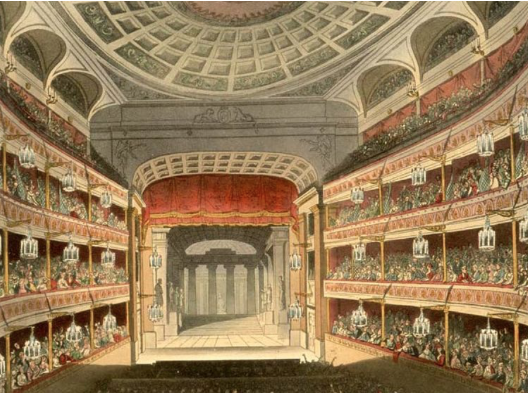
Mistaken has its fair share of twists and turns, and it never hurts to drop a good plot bombshell in a public place—you know, to maximise the impact on your poor unsuspecting characters. The theatre might seem a clichéd choice of public venue, but in the absence of Netflix or Nando’s, it was popular evening entertainment for those reality-TV-starved Regency folk.
In order to make my theatre scenes credible, it was necessary for me to do a fair amount of research, and though most of what I learned has been relegated to a file buried somewhere on my hard drive or a long-forgotten bookmark on my browser, some of what I discovered was more memorable. So before I reveal Elizabeth’s encounter, I thought I’d share some of my own unexpected discoveries about the theatres of the Regency period.
The predominant trait I stumbled upon in my research was their propensity to burn down. With alarming regularity, the playhouses of London were reduced to cinders—a sight altogether greyer and less interesting to watch than the eponymous pantomime that occasionally graced the stages on those rare occasions when they were not engulfed in flames.
The Theatre Royal in Covent Garden burned down twice, as did Her Majesty’s Theatre in Haymarket. The theatre presently situated on Drury Lane is the fourth to have stood on the site, two having burned down and one having been completely demolished just for the fun of it.
All these pyrotechnic shenanigans make writing a historically accurate evening at the theatre during the Regency far trickier than it ought to be. Though I dug up all manner of information about which plays were billed at which times, starring which actors, I invariably found that on the night I needed my characters to attend, the theatre in question was either in the midst of a blazing inferno or the throes of a years-long reconstruction. Thus, other than Darcy’s one mention of “the new theatre on Drury Lane,” (which opened on 10th October, 1812 after—guess what?—a fire!), every other mention of theatres in Mistaken is hopelessly but deliberately vague.
That’s the buildings themselves covered; now onto what went on inside them. Far from the refined, elegant outing I had previously imagined, a typical Regency evening at the theatre seems to have been more akin to a pub lock-in. People arrived early, remained late into the night and consumed food and alcohol in copious quantities as they watched a whole succession performances ranging in nature from high drama to the aforementioned pantomime.
It seems that by the beginning of the C19th, the theatre had ceased to be the bastion of the very rich (not that they were so very well behaved either, but that’s another story). Though the wealthy kept to their private boxes, the lower classes had begun attending in numbers too, squeezing into the gallery up in the rafters and filling up the pits in front of the stage. This led to a mix of people in the audience whose social conventions were rather at odds.
According to the British Library, prostitutes in the pits were a given, riots in the stalls were commonplace and heckling was routine. One doesn’t like to imagine the stately Mr. Darcy partaking in such bawdy behaviour, but it seems to have been de rigueur to hurl at least one “boo” and possibly a rotten tomato at the stage. People talked amongst themselves, sang along to popular songs, and came and went as they pleased throughout the performances—though another snippet of information I happened across led me to think people did not get up and go quite as often as they should have.
According to QI.com, people without the privilege of a box were so unwilling to give up their unreserved seats that they occasionally relieved themselves where they sat. Though such a practice would at least have offered some much needed protection against the constant threat of fire, the problem was so severe that in the mid C19th, a theatre in Newcastle was forced to line the floor of its gallery with lead to save the wealthy patrons in the boxes below from the “inconvenience” of being dripped on.
All in all, my research painted a very different picture of the theatre than I had previously imagined Darcy and Elizabeth might experience—a fact I think readers will see reflected in the theatre scenes in the book. Fortunately, the characters in Mistaken don’t behave quite as poorly as this. That’s not to say they all behave well, mind…
